
Load-bearing capacity of concrete components with basalt fiber rod reinforcement
Brief Description
To prevent corrosion and the resulting costs, fiber-reinforced plastic (FRP) reinforcement elements are a practical alternative to reinforcing steel in many applications involving concrete components. In Germany, but especially in North America, glass-fiber-reinforced plastic (GFRP) reinforcement elements have been widely used in the past. Over the past 10 years or so, the use of high-strength carbon fibers has been developed—primarily by TU Dresden—and implemented in practice through pilot projects. Carbon fibers are characterized by very high tensile strengths of up to approximately 3,500 N/mm² and Young’s moduli of up to 240,000 N/mm². However, carbon fibers are very expensive, and their production is highly CO₂-intensive.
Reinforcement elements made from basalt fiber rods can therefore serve as an alternative. Although the achievable strengths and elastic moduli of the fibers—ranging from 2,000 to 2,500 N/mm² and approximately 90,000 N/mm², respectively—are significantly lower than those of carbon fibers, but the fibers are significantly more cost-effective, and their production is less CO₂-intensive.
Deutsche Basaltfaser Stab GmbH has developed high-strength reinforcing rods from a composite of basalt fibers and synthetic resin, which are characterized above all by excellent bond strength.
As part of several individual projects, the following work has been carried out to date
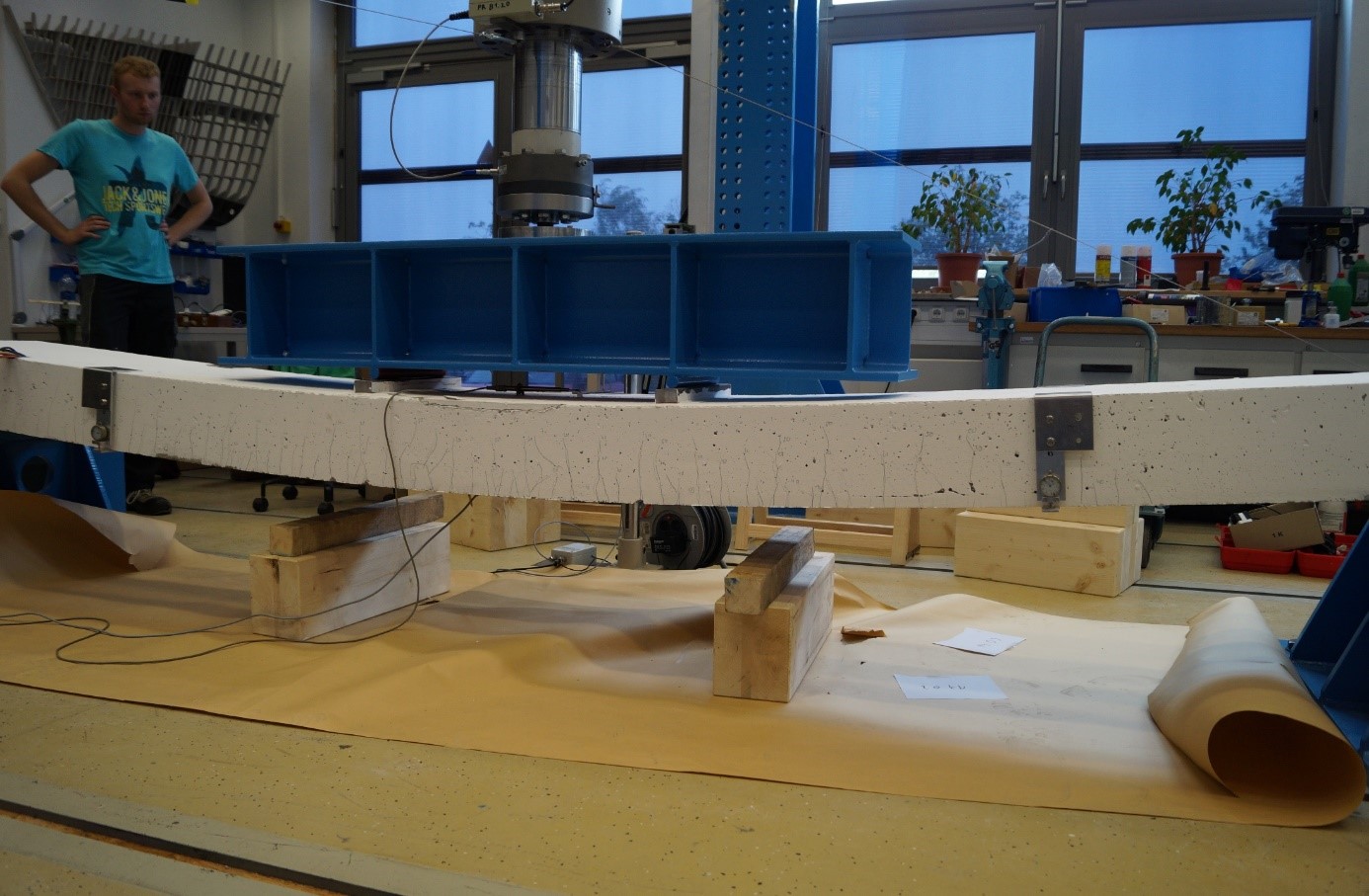
- Component tests for flexural strength
- Component tests for shear strength without shear reinforcement
- Component tests for shear strength with shear reinforcement
Based on these results, projects are currently underway to develop applications such as bridge caps or floor slabs.
See, for example:
Resource-efficient concrete reinforcement for the Info Point Zero Waste Architecture (haw-kiel.de)