
Bridge caps made of recycled concrete with non-metallic reinforcement
Development of resource-efficient, durable, and frost-resistant bridge caps based on the fundamentals of non-metallic reinforcement and concrete made with 100% recycled aggregate
Responsible: | Prof. Dr.-Ing. Stephan Görtz |
Project Management: | Kay Lengert, M.Sc. |
Funding Agency: | Federal Ministry for Buisness and Climate Action, Funding Program: ZIM Koop |
Grant Amount: | €219,711 |
Duration: | June 1, 2021 – June 30, 2023 |
Project Partners: |
|
Brief Description
There are approximately 39,500 bridges in the federal highway network; most of them were built between 1965 and 1985. Many of these structures are in poor condition. The federal government estimates the cost of the most urgent repairs to approximately 5,200 bridge structures at around 9.3 billion euros. In addition to the steadily increasing volume of heavy-duty traffic, the bridges are particularly affected by corrosion of the reinforcing steel. Due to the accumulation of de-icing salt during freezing periods, the side bridge abutments are especially vulnerable and must therefore be replaced, on average, about every 25 years nationwide.
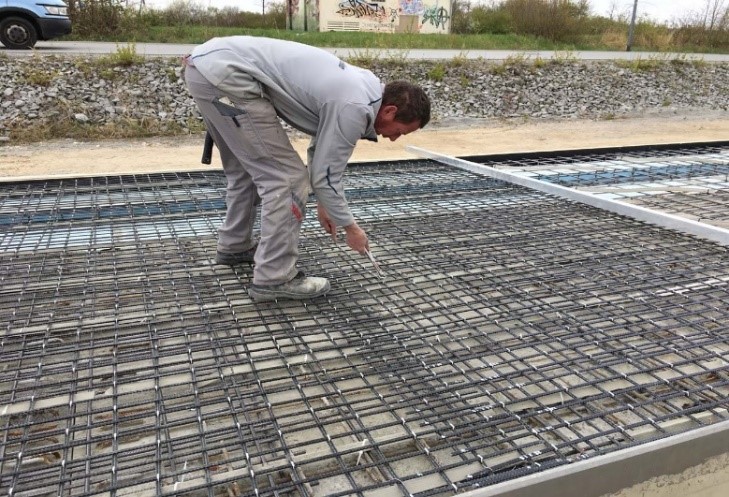
As part of this research project, bridge abutments are to be developed that are both more durable and more sustainable. To increase durability, stainless reinforcement made of basalt fiber-reinforced plastic will be used. The basic load-bearing behavior was preliminarily investigated in component tests conducted by Kiel University of Applied Sciences (see exploratory tests on concrete components with basalt fiber bar reinforcement (haw-kiel.de)). The focus of this research project is on the composite behavior between the reinforcement and the concrete, as well as on the design of the complex cross-sectional reinforcement shape of the caps and the force transmission at the deflections.
In addition, the cap concrete is to be produced entirely (100%) from recycled aggregate. In addition to replacing the aggregate, efforts are being made to process the recycled powder through mechanical and thermal activation so that it exhibits pozzolanic properties, thereby allowing a certain proportion of cement to be substituted. This not only conserves aggregate as a resource but also reduces CO₂ emissions by lowering the cement content.
The functionality of the developed bridge cap is to be tested as part of a large-scale trial.