
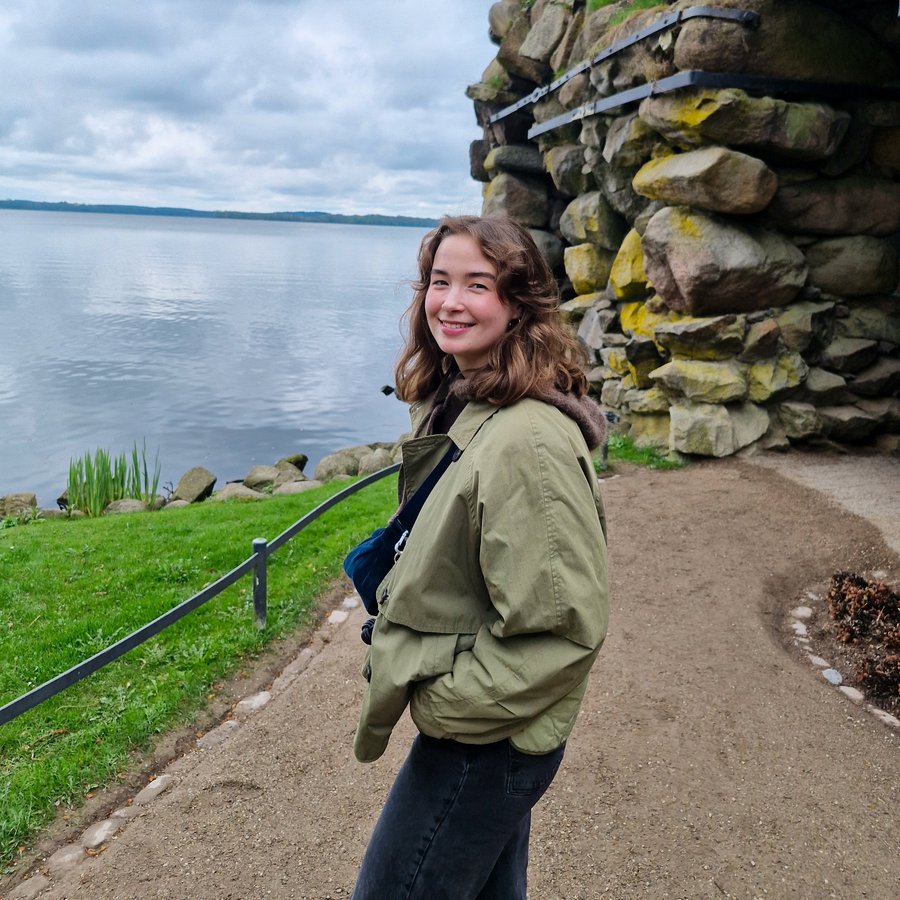
Snow covers the streets, the wind cuts through the air, and every breath turns into a small white cloud. For Polina Liutko, it’s the perfect excuse to stay inside her warm apartment - even though she’s no stranger to much harsher winters. “The east wind that brings the cold here would have been completely normal in my hometown,” she recalls. Liutko came to Germany exactly three years ago. “When the weather feels like this, I always think back to my first days in Kiel,” she says.
The 24-year-old was born and raised in St. Petersburg, a Russian city of around 5.6 million people near the borders of Finland and Estonia. Like Kiel, it lies on the Baltic Sea. In 2023, she left her hometown to begin her studies in Germany.
Liutko’s connection to Germany began at an early age. Growing up in St. Petersburg, she attended a German school - a decision her mother made. "I’m very grateful she did”, Liutko says. But at first, she wasn’t enthusiastic. Learning German was challenging for the nine-year-old and the language felt distant and unfamiliar. That changed when she got a new German teacher. “From that moment on, I became fascinated by Germany”, she reflects. Beyond the regular curriculum, she learned about German culture, history and the education system - and slowly, a long-term dream began to take shape: “Living and studying in Germany became my goal”, she says. After graduating in 2019, Liutko initially stayed in Russia, completing a three-year technical education in St. Petersburg. But the question kept returning: should she leave and study abroad? She knew it would mean a lot paperwork and significant costs. “But my mother always supported me”, she remembers. When Russia invaded Ukraine, her hesitation disappeared. “That was the moment I knew”, she says: “It was time to go.”
Before Liutko could officially start her studies, there was one important step in between: the Studienkolleg. The one-year preparatory program is mandatory for many international students who do not yet qualify for direct admission to a German university. Alongside intensive German classes, participants attend subject-specific courses that prepare them for academic life in Germany. At the Kiel University of Applied Sciences, international students can choose between an economical or a technical track. Places are limited and competition is strong: only about 50 students are admitted each year, selected through an entrance exam in German and mathematics. At the most recent admission test in January 2025, 355 applicants competed for a spot.
Liutko arrived in Kiel two days before her entrance exam - just enough time to get a first impression of the city. “I lived near Blücherplatz, such a beautiful area for a Spaziergang”, she says with a laugh. On exam day, she had to get up early and take the bus to campus. “It was cold and windy - not the perfect start for such an important day,” she says. But once she arrived, her nerves slowly faded. “Everything felt so modern, so progressive,” she remembers her first impression of the campus. The Studienkolleg team welcomed her and the other applicants warmly. She says she immediately felt comfortable. “I had this feeling inside me - this could be it. This could be my university.” The following days felt long. “Even though I knew I had done well in the exam, I was still nervous”, she admits. Then came the moment she had been waiting for: a ping from her mailbox. The confirmation was there - she had been accepted to the Studienkolleg at Kiel UAS. “It was such a happy day,” she says, “I’ll never forget it.”
After completing her year at the Studienkolleg, Liutko decided to stay at Kiel UAS and start a Bachelor’s program in Business Administration. Besides liking the Kiel UAS itself, Kiel had begun to feel like home. “I made friends, dated a guy, and continued my hobby,” she says. Back in St. Petersburg, Liutko used to play volleyball and she picked it up again in Germany. Joining a team helped her settle in and meet new people. “When you join a team, you automatically get 15 new friends,” she says, laughing. Still, the transition wasn’t easy. “The first year of my bachelor’s was hard”, she admits. Despite learning German from a young age and being well prepared by the Studienkolleg, academic German proved challenging. “I had a headache almost every day”, she remembers. Things got better once she stopped translating in her head and began thinking in German. Since then, studying has become much easier. One moment, in particular, still makes her proud: an exam in private law. “Even German students struggled with the wording,” she explains. After studying all day, her effort paid off: she passed with a 100 Percent score.
Even though living in Germany had always been Liutko’s dream, there are moments when she thinks about her homeland. “My Russian soul misses the music, the literature and the culture,” she reflects. At least she is still able to visit her family every few months — they have also left Russia and now live in Belgium. In Germany, Liutko feels fortunate to have found a close Russian friend. “When we’re together, everything just fits because we share the same background”, she explains. At the same time, she has discovered unexpected similarities between the two countries. “Like Russians, Germans are very honest,” she says, laughing, “If they like or dislike something, they’ll tell you.” After completing her bachelor’s degree, Liutko plans to move to a larger German city. “I grew up in the metropolis of St. Petersburg, and sometimes I miss the big city energy”, she explains. There, she wants to either start a master’s program or work for an international company. “I want to travel across Europe,” she says and adds, “I really value the freedom the EU offers.” Returning to Russia is not an option for her. “It has always been my dream to live here,” she says - before smiling and adding, “Little Polina would be so excited and proud.”
A journey that started with two big suitcases and a dream has become a whole new life for Polina Liutko. Today, Germany is no longer just the country where she studies - it is where she has built friendships, found her routine, and shaped her future. For others thinking about taking a similar step, she has clear advice: “Dare to take different paths. Stay true to yourself and never lose your identity. The right people will come and they will turn any place into a home.”