![[Translate to English:] Drei Menschen an einem Gerät.](/fileadmin/_processed_/a/8/csm__260416_pm-battery-technologies_04_m_hanke_b203780486.jpg)
When asked to briefly summarise the new programme at Kiel University of Applied Sciences, Christoph Weber replied: “The internationally oriented master's program is aimed particularly at students who wish to deepen their technical skills and become involved in the field of future technologies.” Specifically, using the complete battery production cycle as an example, all essential aspects from conception and manufacturing to end-of-life use are taught over three semesters. “Graduates gain a comprehensive understanding of the entire chain. This enables them to think, communicate, and act across disciplines,” Weber continued.
Professor Dr. Christoph Weber has been at the university since 2008. The head of the new Battery Technologies programme sees energy storage as a key pillar of the energy transition: “Smart batteries are needed at all levels – from production and operation to end-of-life. Therefore, we have also included recycling in the programme. Using batteries as an example, we show students how demand-oriented, high-performance, effective, and intelligent components are manufactured through the interaction of hardware and software, and we empower them to control the relevant processes.”
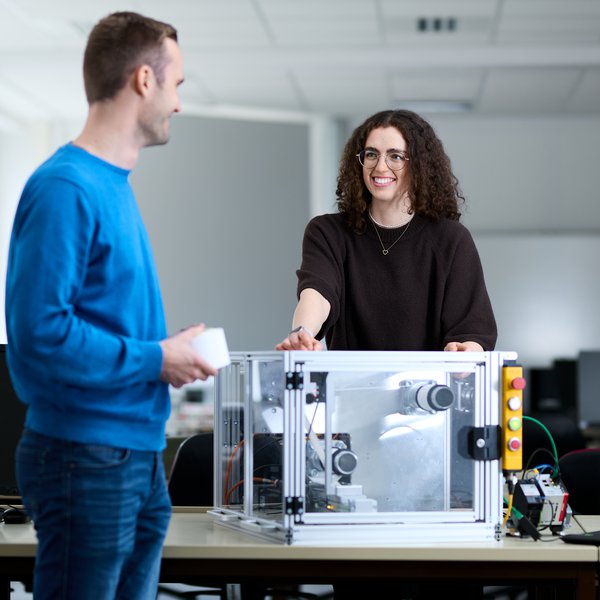
In addition to the English-language instruction, another unique feature is that the degree programme takes place at three locations. “At the HAW Kiel, for example, we have set up a laboratory to teach automation technology in a practical way,” Weber said and further explained, “The model of a roll-to-roll test bench for continuous manufacturing processes used the same components and software used in industrial production plants.” Just a few bus stops from the HAW Kiel is the Faculty of Engineering at Kiel University (CAU Kiel). “The Faculty of Engineering teaches the specific fundamentals in materials science and electrochemistry,” the professor added, outlining the university’s programme of courses.
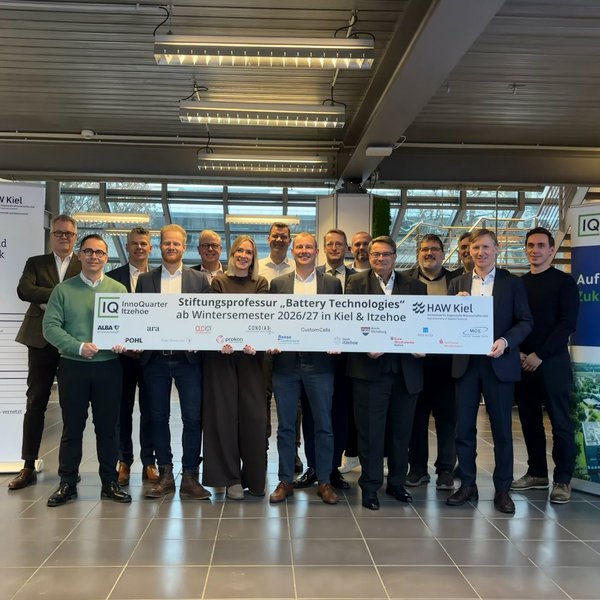
The third stop is Itzehoe, about 60 kilometres away, home to the Fraunhofer Institute for Silicon Technology (ISIT) and numerous technology companies. “Here, students have the opportunity to experience real production processes, engage in dialogue with experts, and find current and relevant topics for their theses,” explaining the concept, Weber added, “Many of the companies are looking for skilled workers. The time in Itzehoe is an ideal opportunity to get to know each other. To ensure that students can focus on the content, we have also included a bus shuttle in the programme’s design.”
The master’s program is aimed particularly at those with a technical background in fields such as electrical engineering, mechatronics, and industrial engineering who want to deepen their knowledge and help shape the energy transition. One of them is Paul Stampa, who is about to complete his bachelor’s degree. He is particularly drawn to the interdisciplinary nature of Battery Technologies, explaining his choice: “Being able to not only communicate but also act with stakeholders from different disciplines at all levels of the production processes is a key skill for developing hardware and software solutions in complex systems.”
Further information about the master's programme in Battery Technologies, the requirements for interested parties and the application process can be found on the [Programme Webseite].